

cPanel to Office 365 Migration: Complete Step-by-Step Guide (2026)
Many businesses start with email accounts bundled inside their web hosting package. It feels simple in the beginning: create email accounts in cPanel, connect them to Outlook or mobile, and continue working. But as the business grows, cPanel-hosted email can become difficult to manage. Mailbox storage becomes limited, security options are basic, collaboration is weak, and administration becomes harder when users, devices, and departments increase.
That is why many organizations plan a cPanel to Office 365 migration. By moving from cPanel email to Microsoft 365 Exchange Online, businesses can improve mailbox management, Outlook integration, mobile access, identity control, collaboration, and long-term scalability.
This guide explains the complete process in simple steps: preparation, Microsoft 365 setup, IMAP migration, DNS cutover, verification, limitations, troubleshooting, and post-migration configuration.
Office 365 vs Microsoft 365: Important Naming Note
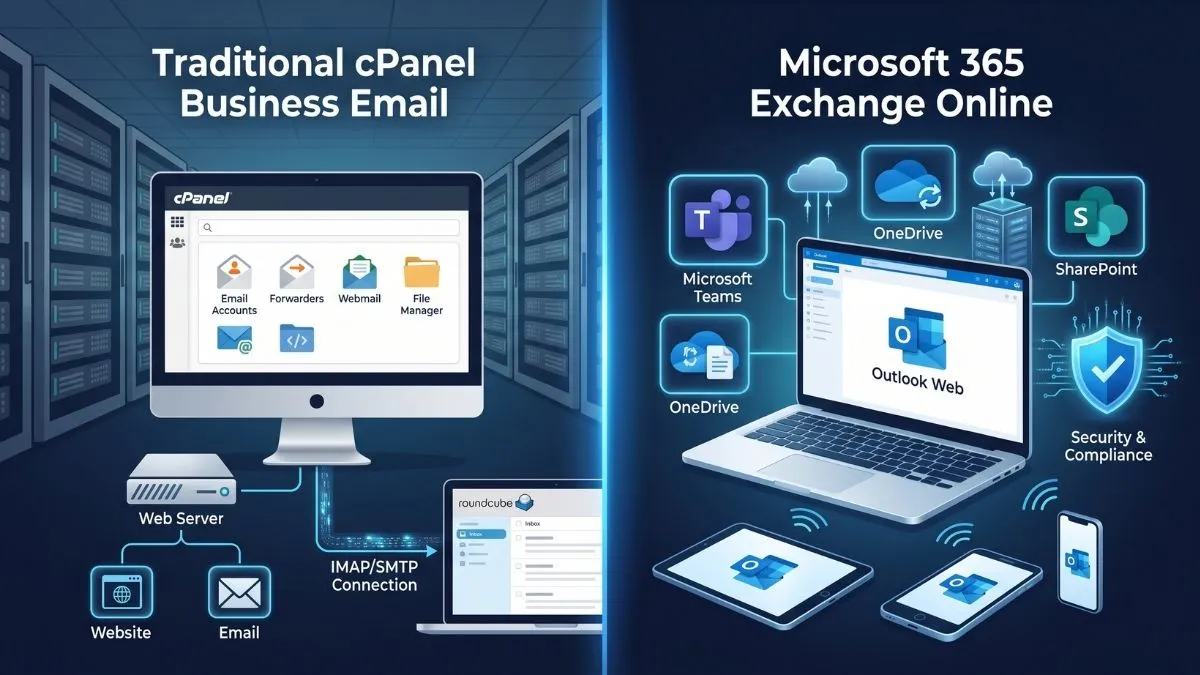
Office 365 is now commonly referred to as Microsoft 365, but many business owners and IT administrators still search for “Office 365 migration.”
In this guide, both terms refer to moving business email from cPanel-hosted email to Microsoft 365 Exchange Online. The goal is the same: migrate old email data, configure Microsoft 365 mailboxes, change DNS records correctly, and make sure users can send and receive email without major disruption.
What Does cPanel to Office 365 Migration Mean?
A cPanel to Office 365 migration means moving your business email service from a hosting-based email system to Microsoft 365, specifically Exchange Online.
In most cPanel hosting environments, email is managed from the same hosting control panel used for the website. The email accounts are usually created inside cPanel under the domain name. For example, if your domain is example.com, your email accounts might be info@example.com, sales@example.com, and support@example.com.
These mailboxes are normally accessed using protocols such as IMAP, POP, and SMTP. Users connect their cPanel email to Outlook, Thunderbird, Apple Mail, mobile mail apps, or webmail.
Microsoft 365 works differently. Instead of hosting your mailbox on the same server as your website, your email is hosted in Microsoft Exchange Online. Users can access email through Outlook, Outlook on the web, mobile apps, and Microsoft 365 services.
During an IMAP migration, the email messages and folders from the old cPanel mailbox are copied to the new Microsoft 365 mailbox. However, IMAP migration normally moves email only. It does not migrate contacts, calendars, tasks, rules, signatures, or local Outlook data stored only on a device.
It is also important to understand the difference between migrating old email data and changing email delivery.
Email migration means copying existing mailbox data from cPanel to Microsoft 365.
Email delivery cutover means changing the domain’s MX record so that new incoming emails start arriving in Microsoft 365 instead of cPanel.
Both steps are necessary for a successful migration. If you copy old emails but do not change the DNS records, new emails will still go to the old cPanel server. If you change DNS without migrating old emails, users will receive new emails in Microsoft 365, but their old mailbox data may remain in cPanel.
Based on Real Microsoft 365 Migration Experience
In real cPanel to Microsoft 365 migrations, the biggest problems usually happen because of missing preparation rather than the migration tool itself.
Common real-world issues include missing mailbox passwords, incorrect IMAP server details, old POP emails stored only in Outlook, forgotten forwarders, aliases not recreated, wrong MX changes, and Outlook profiles still connected to the old cPanel server.
That is why this guide focuses not only on copying email, but also on planning, DNS cutover, mail flow testing, user support, and post-migration security configuration.
Why Businesses Move from cPanel Email to Microsoft 365
Businesses usually move from cPanel email to Microsoft 365 because their email needs become more professional and demanding over time.
Centralized Administration
With cPanel email, mailbox administration is tied to the hosting account. This may be fine for a small setup, but it becomes harder when there are many users, departments, password resets, access issues, and device configurations.
Microsoft 365 provides centralized user and mailbox administration. IT teams can manage users, licenses, groups, shared mailboxes, permissions, and security settings from Microsoft admin centers.
Larger and Scalable Mailbox Options
Many shared hosting email accounts have strict storage limits. When users receive large attachments or keep years of email history, mailbox space can become a problem.
Microsoft 365 offers more scalable mailbox options depending on the selected plan. This makes it easier for businesses to support users who need larger mailboxes, archiving, and long-term email access.
Better Outlook Integration
Although cPanel email can be added to Outlook using IMAP, the experience is usually limited. Users may face sync issues, sent folder mismatches, password prompts, or calendar limitations.
With Exchange Online, Outlook integration is much stronger. Email, calendar, contacts, shared mailboxes, meeting invitations, and mobile access work more smoothly inside the Microsoft ecosystem.
Microsoft Teams Integration
Modern businesses need more than email. They need meetings, chat, file sharing, and collaboration. Microsoft 365 connects email with Teams, OneDrive, SharePoint, calendars, and groups.
This helps teams move beyond basic email communication and work in a more connected environment.
OneDrive and SharePoint Ecosystem
A cPanel email system does not provide a complete document collaboration platform. Microsoft 365 includes OneDrive and SharePoint, which allow users to store, share, and collaborate on files more effectively.
This is especially useful for businesses that need controlled access, shared folders, department files, and collaboration across locations.
Security and Identity Management
Microsoft 365 provides identity and access management features such as multi-factor authentication, conditional access, sign-in monitoring, and security policies depending on the license and configuration.
However, Microsoft 365 is not automatically secure just because you migrate. Security depends on how it is configured. SPF, DKIM, DMARC, MFA, password policies, anti-phishing policies, and access controls should all be reviewed after migration.
Mobile Access
Users often access business email from mobile phones. With cPanel email, mobile configuration can be inconsistent because each device may need manual IMAP and SMTP settings.
Microsoft 365 improves the mobile experience through Outlook mobile and Exchange ActiveSync-style access, making email, calendar, and contacts easier to manage across devices.
Business Continuity
If your website hosting server has problems, cPanel-hosted email may also be affected. This means website downtime and email downtime can happen together.
Moving email to Microsoft 365 separates email from web hosting. Your website can remain on cPanel while your email runs through Microsoft 365. This reduces dependency on one hosting server.
Reduced Dependency on Web Hosting Email
As a business grows, email becomes too important to depend only on basic hosting email. Microsoft 365 gives organizations a dedicated business email platform with better administration, collaboration, and long-term scalability.
What You Need Before Starting the Migration
Before starting a cPanel to Office 365 migration, gather all required access, mailbox details, DNS information, and backup plans. Most migration problems happen because businesses begin the process without a complete inventory or without access to the domain DNS zone.
Use this checklist before starting:
| Requirement | Why It Is Needed |
| cPanel administrator access | To view mailboxes, reset passwords, check forwarders, and confirm IMAP settings |
| Microsoft 365 administrator access | To create users, assign licenses, configure Exchange Online, and manage migration batches |
| Domain/DNS access | To verify the domain and update MX, SPF, Autodiscover, DKIM, and DMARC records |
| List of existing mailboxes | To make sure every active email account is migrated |
| Mailbox usernames/passwords or suitable administrative access | Required for IMAP migration authentication |
| Existing mailbox sizes | Helps estimate migration time and identify large mailboxes |
| Existing aliases and forwarding addresses | Needed to recreate routing rules in Microsoft 365 |
| Distribution addresses | Required if group emails such as sales@ or support@ are used |
| IMAP server hostname | Needed to connect Exchange Online to the cPanel mail server |
| IMAP SSL port/settings | Required for secure mailbox synchronization |
| Microsoft 365 licenses | Required so users have active Exchange Online mailboxes |
| Backup/rollback planning | Helps recover if DNS, mail flow, or migration issues occur |
DNS access is especially critical because email delivery is controlled by DNS records. You can migrate mailbox data from cPanel to Microsoft 365, but new incoming emails will not start arriving in Microsoft 365 until the MX record is changed. Without DNS access, you cannot complete the final cutover.
Also remember that DNS changes affect live mail flow. If the MX record is changed too early, emails may start routing to Microsoft 365 before mailboxes are ready. If it is changed incorrectly, messages may bounce or continue going to the old cPanel server. Always confirm the Microsoft 365 environment, migration batch, and mailboxes before changing DNS.
Important IMAP Migration Limitations
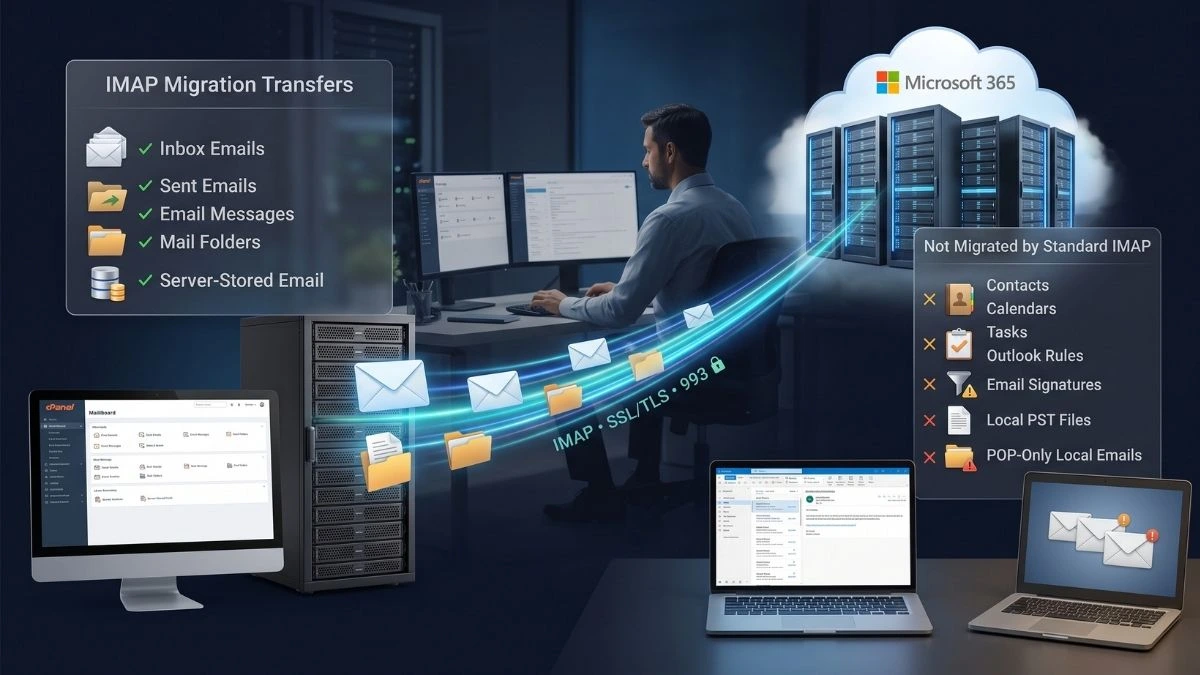
This is one of the most important sections to understand before starting. A standard IMAP migration does not move everything inside a user’s email profile.
IMAP migration primarily transfers email messages and folders from the source mailbox to the destination Microsoft 365 mailbox. It is useful for moving email data from cPanel-hosted email to Exchange Online, but it does not fully recreate the user’s complete Outlook experience.
Standard IMAP migration usually moves:
- Inbox messages
- Sent messages stored on the server
- Custom mail folders
- Server-side email messages
However, standard IMAP migration usually does not migrate:
- Contacts
- Calendars
- Tasks
- Outlook rules
- Email signatures
- Local PST files
- POP-downloaded messages not stored on the server
- Some shared mailbox structures
- Some permissions and delegation settings
This means “email migration” should not be misunderstood as “everything migration.” If users have important contacts or calendar events stored in Outlook, mobile devices, or webmail, those may need to be exported and imported separately.
Large messages can also cause problems. Some very large attachments may fail depending on source server limits, Microsoft 365 limits, or migration settings. Very large mailboxes may take longer to synchronize, especially if the cPanel server has performance limits or connection restrictions.
Problematic items can also appear during migration. These may include corrupted messages, unsupported formats, unusual folder names, very deep folder structures, or old archived mail stored outside the active IMAP mailbox.
Deleted and archived mail should also be checked carefully. If deleted items are still stored in a server folder, they may migrate. If archived messages are stored locally in Outlook PST files, they will not migrate through standard IMAP.
Mailbox credentials are another key limitation. IMAP migration normally requires access to each source mailbox username and password. If passwords are missing or incorrect, the migration will fail for those users.
When IMAP Migration Is Not Enough
IMAP migration is suitable for many simple cPanel to Microsoft 365 email migrations, but it is not always enough.
You may need a more advanced migration method or professional migration support if:
– Users need contacts and calendars migrated
– Users have important PST files stored locally in Outlook
– Many users are using POP accounts
– The company has large mailboxes
– There are shared mailboxes, aliases, and forwarding rules
– The business uses multiple domains
– There are compliance or retention requirements
– Downtime risk is very low
– Users need Outlook and mobile setup support
– The company needs post-migration security hardening
For very small businesses with only a few simple mailboxes, IMAP migration may be enough. For larger or more sensitive environments, proper planning and professional support can reduce risk.
Step-by-Step cPanel to Office 365 Migration Process
Step 1 – Audit Your Existing cPanel Mailboxes
Start the migration by creating a complete inventory of all existing cPanel mailboxes. This audit helps you understand what exists, what needs to move, and what can be cleaned up before migration.
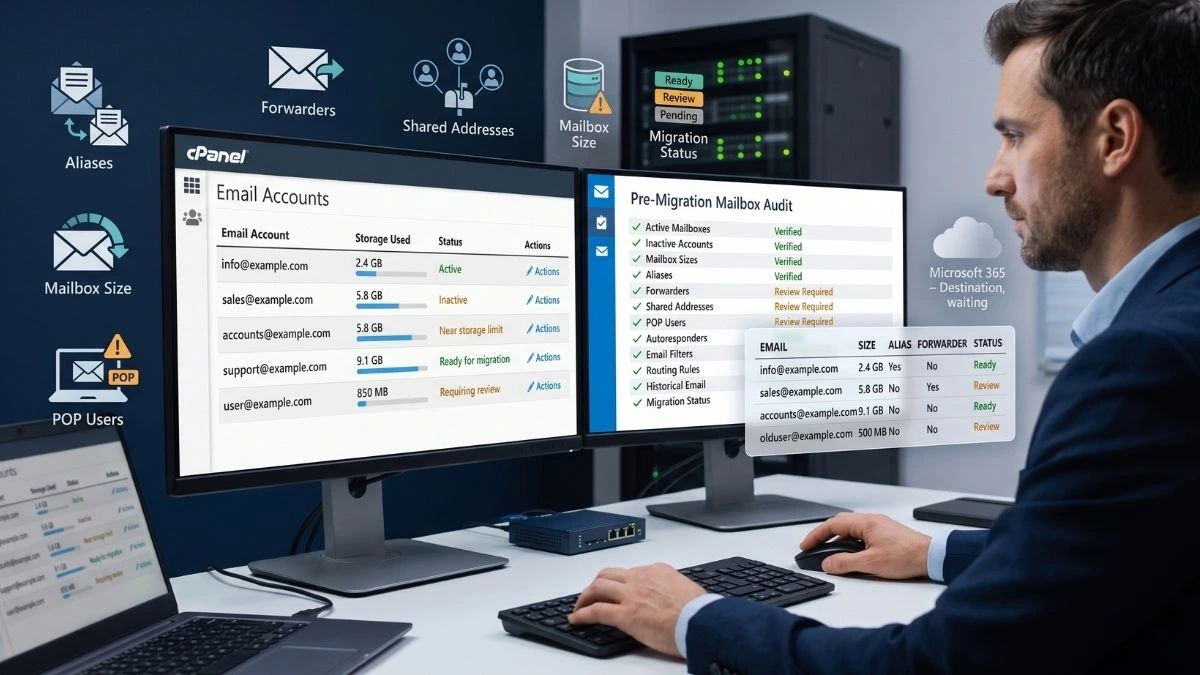
Use a table like this:
| Email Address | Mailbox Size | Alias | Forwarder | Migration Status |
| info@example.com | 2.4 GB | Yes | No | Pending |
| sales@example.com | 5.8 GB | No | Yes | Pending |
| accounts@example.com | 9.1 GB | No | No | Pending |
| olduser@example.com | 500 MB | No | No | Review |
During the audit, check:
- Active mailboxes
- Inactive accounts
- Mailbox sizes
- Forwarders
- Aliases
- Catch-all configuration
- Shared addresses
- Department accounts
- Important historical mail
- POP users
- Autoresponders
- Filters and routing rules
This step is important because not every email address in cPanel should become a licensed Microsoft 365 user. Some addresses may be better recreated as shared mailboxes, aliases, distribution lists, or Microsoft 365 groups.
For example, info@, sales@, and support@ may not need separate paid user mailboxes if they are used by multiple staff members. They may work better as shared mailboxes or distribution addresses depending on business needs.
An audit also prevents surprises. Without it, you may discover after cutover that an important forwarder was missed, a mailbox was inactive but still needed, or a shared address stopped receiving email.
Step 2 – Set Up Microsoft 365
After auditing cPanel, prepare the Microsoft 365 environment.
First, create or prepare the Microsoft 365 tenant. Then add the organization’s domain, such as example.com, in the Microsoft 365 admin center. Microsoft will ask you to verify domain ownership by adding a TXT record to your DNS zone.
This verification step proves that you own the domain. It does not mean you need to switch the MX record immediately.
This point is very important. You can verify the domain in Microsoft 365 while still keeping email delivery on cPanel. The MX record should only be changed when your Microsoft 365 mailboxes are ready and your migration plan is prepared.
Next, create the required users in Microsoft 365 and assign the appropriate licenses. Make sure the users have Exchange Online mailboxes. If a user does not have a mailbox, migrated email will not have a proper destination.
Before moving forward, confirm:
- The Microsoft 365 tenant is active
- The domain is verified
- Users are created
- Email addresses are correct
- Licenses are assigned
- Exchange Online mailboxes exist
- Shared mailboxes or distribution groups are planned
- Admin access is working
Do not rush this stage. A properly prepared Microsoft 365 tenant makes the migration much smoother.
Step 3 – Prepare the cPanel IMAP Environment
Next, prepare the source email system. Microsoft 365 needs to connect to the cPanel mailboxes using IMAP.
In cPanel, go to the email account settings and look for the mail client configuration or “Connect Devices” option. This area normally shows the correct incoming and outgoing server settings.
A typical secure IMAP configuration may look like this:
| Setting | Example |
| IMAP server | mail.example.com |
| Port | 993 |
| Encryption | SSL/TLS |
| Username | Full email address |
| Password | Mailbox password |
Use the actual values provided by your hosting provider. Do not assume that every cPanel server uses the same hostname. Some providers use mail.example.com, while others may use the server hostname.
Before creating the migration endpoint, test IMAP access for at least one mailbox. You can test using Outlook, Thunderbird, Apple Mail, or another IMAP client.
Check the following:
- IMAP hostname is correct
- SSL/TLS works
- Port 993 is open
- Username format is correct
- Password is correct
- Remote IMAP access is allowed
- Hosting provider does not block migration connections
- Source server has reasonable connection limits
Some shared hosting servers limit the number of simultaneous IMAP connections. If you are migrating many users, consider smaller migration batches to avoid connection failures.
Step 4 – Create the Migration Endpoint in Exchange Online
A migration endpoint is a connection profile inside Exchange Online. It tells Microsoft 365 how to connect to the old cPanel IMAP server.
In simple terms, the endpoint answers this question:
“How should Microsoft 365 connect to the source email server to copy mailbox data?”
At a high level, the Exchange Admin Center workflow is:
Exchange Admin Center → Migration → Add migration endpoint → IMAP
The exact interface may change over time, but the required information is usually similar.
You will need to provide:
- Source IMAP server hostname
- IMAP port
- Encryption method
- Authentication settings
- Connection settings
For most cPanel environments, secure IMAP uses port 993 with SSL/TLS. After entering the details, Exchange Online validates the connection.
If validation fails, check the IMAP hostname, DNS resolution, port, SSL certificate, firewall restrictions, and mailbox credentials. Do not move to the migration batch step until the endpoint works correctly.
Step 5 – Prepare the Mailbox Migration CSV
For IMAP migration, Microsoft 365 needs a CSV file that tells it which source mailbox should migrate into which Microsoft 365 mailbox.
A basic IMAP migration CSV uses the following concept:
EmailAddress,UserName,Password
user1@example.com,user1@example.com,SourceMailboxPassword
user2@example.com,user2@example.com,SourceMailboxPassword
The three important fields are:
| Field | Meaning |
| EmailAddress | The destination Microsoft 365 mailbox address |
| UserName | The source cPanel mailbox username, often the full email address |
| Password | The source cPanel mailbox password |
Never use real customer credentials in examples, documentation, screenshots, or training material. During a real migration, the CSV file contains sensitive information and must be handled securely.
Security best practices:
- Store the CSV only in a secure location
- Limit access to migration administrators
- Do not email the file openly
- Do not upload it to unsecured storage
- Delete or securely archive it after migration
- Reset source mailbox passwords if required by policy
Before migrating all users, test with one or two non-critical mailboxes. This confirms that the CSV format, credentials, endpoint, and mailbox mapping are correct.
Step 6 – Create and Start the Migration Batch
After the endpoint and CSV file are ready, create the migration batch.
The general workflow is:
Exchange Admin Center → Migration → Add migration batch → Migrate to Exchange Online → IMAP migration
During this step, you will:
- Upload the user CSV file
- Select or create the IMAP migration endpoint
- Choose migration batch settings
- Start synchronization
- Monitor mailbox progress
A migration batch copies email from each cPanel source mailbox into the matching Microsoft 365 mailbox. For small businesses, one batch may be enough. For larger organizations, it is better to divide users into smaller batches.
Example batch structure:
- Batch 1: Management
- Batch 2: Sales
- Batch 3: Accounts
- Batch 4: Support
- Batch 5: Remaining users
Smaller batches are easier to monitor and troubleshoot. If one group has errors, it does not block the entire migration project.
Step 7 – Monitor and Verify Mailbox Migration
Monitoring is not just about checking whether the migration status says “completed.” You should verify the mailbox content carefully.
Check the following:
- Migrated item counts
- Failed item counts
- Folder structure
- Inbox messages
- Sent Items
- Important folders
- Recent messages
- Large mailboxes
- User mailbox accessibility
- Date ranges of migrated email
- Missing or duplicated folders
- Migration error reports
A migration batch may show a successful status, but that does not always mean every important item has been reviewed. Always open sample mailboxes and verify real content.
For each department, ask one or two key users to check important folders. This is especially useful for accounts, management, sales, and support teams where historical mail may be business-critical.
Also check whether sent emails migrated correctly. In some cPanel environments, sent items may be stored in different folder names such as Sent, Sent Items, or another webmail-specific folder.
If some items fail, review the migration report before completing the project.
Step 8 – Change DNS and MX Records
DNS cutover is the highest-risk part of the migration because it controls live email delivery.
The MX record determines where new incoming email is delivered. Before cutover, the MX record normally points to the cPanel or hosting provider mail server. After cutover, it should point to Microsoft 365.
Do not switch the MX record before confirming:
- Microsoft 365 users are created
- Exchange Online mailboxes exist
- Licenses are assigned
- Migration batch has started successfully
- Important mailboxes are synchronized
- DNS access is confirmed
- Users are informed
- Rollback plan is ready
Important Microsoft 365 DNS records include:
| Record | Purpose |
| MX | Routes incoming email to Microsoft 365 |
| Autodiscover CNAME | Helps Outlook find Microsoft 365 mailbox settings |
| SPF TXT | Identifies authorized sending servers |
| DKIM | Adds email signing for outbound messages |
| DMARC | Defines how receiving servers handle SPF/DKIM alignment failures |
SPF, DKIM, and DMARC are important for deliverability and authentication. If the business uses website forms, CRM systems, marketing platforms, accounting software, or third-party SMTP services, those senders must also be considered.
Avoid creating multiple SPF records. A domain should normally have one SPF TXT record that includes all authorized sending sources.
Sample Microsoft 365 DNS Records
After changing mail delivery to Microsoft 365, you must configure the correct DNS records. The exact values should always be copied from your Microsoft 365 admin center because they can vary by tenant and domain.
Here is a general example of the records normally required:
| Record Type | Example / Purpose |
|---|---|
| MX | Routes incoming email to Microsoft 365 |
| TXT (SPF) | Authorizes Microsoft 365 to send email for your domain |
| CNAME (Autodiscover) | Helps Outlook automatically find mailbox settings |
| CNAME (DKIM) | Enables email signing for better authentication |
| TXT (DMARC) | Tells receiving servers how to handle SPF/DKIM failures |
A common SPF example for Microsoft 365 is:
`v=spf1 include:spf.protection.outlook.com -all`
However, if your domain also sends email from a website form, CRM, accounting software, or marketing platform, those sending sources must also be included in your SPF planning.
Do not create multiple SPF records. A domain should normally have only one SPF TXT record that includes all authorized sending services.
Step 9 – Test Mail Flow After Cutover
After changing DNS, test mail flow carefully. Do not assume everything is working just because no immediate bounce messages appear.
Use this checklist:
- Send from external Gmail/Yahoo account to Microsoft 365 mailbox
- Send from Microsoft 365 mailbox to external email
- Send internal email between Microsoft 365 users
- Reply to an old email thread
- Test Outlook web access
- Test Outlook desktop setup
- Test Outlook mobile access
- Test shared or functional addresses such as info@ and support@
- Check spam/junk folder behavior
- Verify attachments are received
- Confirm Autodiscover is working
- Verify SPF record
- Enable and verify DKIM
- Configure and test DMARC
Also review message headers if delivery problems occur. Headers can help confirm whether messages are passing SPF, DKIM, and DMARC checks.
Step 10 – Complete the Migration
After mail flow is verified, complete the final migration steps.
Before closing the migration project:
- Confirm synchronization status
- Review failed items
- Check important folders
- Confirm recent emails arrived in Microsoft 365
- Verify sent items and custom folders
- Confirm user access
- Test mobile and Outlook profiles
- Confirm shared mailboxes and distribution groups
- Notify users that cutover is complete
When appropriate, stop or remove the migration batch. However, do not immediately delete the old cPanel mailboxes or source data. Keep the old environment temporarily according to your rollback and retention plan.
This is important because some users may later report missing historical emails. Keeping the source available for a short period gives you time to verify and recover if needed.
After cutover, users may need to reconfigure Outlook or create a new Outlook profile. Mobile users should also be guided to remove old IMAP accounts and add the Microsoft 365 account properly.
Post-Migration Security Checklist
After the migration is complete, review Microsoft 365 security settings before considering the project fully finished.
Important post-migration security tasks include:
– Enable multi-factor authentication for users
– Configure SPF, DKIM, and DMARC
– Review anti-spam and anti-phishing policies
– Disable or remove unused old cPanel mailboxes
– Review mailbox forwarding rules
– Set up shared mailbox permissions properly
– Review admin accounts and access permissions
– Document DNS records and admin credentials securely
Many email problems happen after migration because the environment is not configured properly. A successful migration should include both mail flow testing and security review.
Common Client Mistakes During cPanel to Office 365 Migration
Many migration issues happen because small but important details are missed before cutover.
Common mistakes include:
– Changing the MX record before Microsoft 365 mailboxes are ready
– Not confirming all mailbox passwords
– Forgetting aliases, forwarders, and distribution addresses
– Not checking whether users are using POP instead of IMAP
– Creating paid user mailboxes for addresses that should be shared mailboxes
– Not testing IMAP access before creating the migration batch
– Not lowering DNS TTL before cutover
– Forgetting to configure SPF, DKIM, DMARC, and Autodiscover
– Not testing Outlook desktop and mobile after migration
– Deleting old cPanel mailboxes too soon
Avoiding these mistakes can reduce downtime, prevent missing emails, and make the migration smoother for users.
Common cPanel to Office 365 Migration Problems
| Problem | Possible Cause | What to Check |
| IMAP connection fails | Wrong server, port, SSL setting, or firewall restriction | Confirm IMAP hostname, port 993, SSL/TLS, and remote access |
| Authentication fails | Incorrect username or password | Verify full email username and reset cPanel mailbox password if needed |
| Some emails missing | IMAP limitations, POP usage, filters, or local PST storage | Review migration report and check whether mail exists on the server |
| New mail goes to old server | MX record still points to cPanel | Check DNS configuration and MX priority |
| Outlook does not configure | Autodiscover record missing or incorrect | Verify Microsoft 365 Autodiscover DNS |
| Mail goes to spam | SPF, DKIM, or DMARC not configured correctly | Review authentication records and message headers |
| Migration is very slow | Large mailboxes or source server connection limits | Use smaller batches and monitor source server performance |
| Duplicate emails appear | Previous imports or repeated sync attempts | Review affected folders before deleting anything |
| Website forms stop sending | Website still uses old cPanel SMTP | Update SMTP settings or use an approved sending method |
| Shared addresses stop working | Forwarders or aliases not recreated | Recreate shared mailboxes, aliases, or distribution groups |
How Long Does cPanel to Microsoft 365 Migration Take?
There is no fixed migration duration. The total time depends on several factors, including:
- Number of users
- Mailbox sizes
- Number of email items
- Source server performance
- IMAP connection limits
- Internet and network conditions
- Large attachments
- Migration errors
- DNS propagation
- User device configuration
It is helpful to separate the project into three stages.
Preparation includes auditing mailboxes, setting up Microsoft 365, verifying the domain, creating users, assigning licenses, and preparing the CSV file.
Synchronization is the process of copying old email data from cPanel to Microsoft 365. This may take longer for large mailboxes or slow hosting servers.
Final cutover is when DNS records are changed and new incoming mail starts arriving in Microsoft 365.
A small migration may be completed quickly if all access is available and mailboxes are small. Larger migrations should be planned carefully and may need staged batches.
Can You Migrate Without Email Downtime?
It is possible to minimize disruption, but it is not responsible to promise zero downtime in every case.
A good migration plan uses pre-synchronization. This means email data is copied from cPanel to Microsoft 365 before the MX record is changed. After most mailbox data is synchronized, the DNS cutover is scheduled during a low-traffic period.
This approach helps reduce disruption because users do not wait for all old mail to migrate after the cutover. Most historical data is already in Microsoft 365 before new mail starts arriving there.
To reduce the risk of missed messages:
- Start synchronization before cutover
- Lower DNS TTL in advance if possible
- Change MX only after verification
- Keep old cPanel mailboxes temporarily
- Run final sync after cutover
- Test mail flow from multiple external accounts
- Monitor both old and new systems during transition
Careful planning can greatly reduce downtime and missed emails, but DNS propagation, user devices, source server behavior, and configuration mistakes can still create temporary disruption.
Should You Migrate cPanel Email Yourself or Use a Microsoft 365 Migration Specialist?
Self-migration may be suitable if the setup is simple and the risk is low.
You may be able to migrate yourself if:
- The organization has very few mailboxes
- Mailboxes are small
- Users only need email messages migrated
- You have all mailbox passwords
- You understand DNS records
- You have Microsoft 365 admin experience
- Downtime risk is acceptable
A Microsoft 365 migration specialist becomes more valuable when the environment is more complex.
Professional help is recommended when there are:
- Many users
- Large mailboxes
- Critical business email
- Multiple domains
- Shared mailboxes
- Aliases and distribution groups
- Complex DNS
- Website SMTP dependencies
- Compliance or security requirements
- Minimal tolerance for downtime
- Users needing Outlook and mobile support
- Contacts, calendars, or PST data to migrate
A specialist can help with planning, migration batches, DNS cutover, troubleshooting, Outlook setup, security configuration, and user support after migration.
cPanel Email vs Microsoft 365
| Area | cPanel Email | Microsoft 365 / Exchange Online |
| Email hosting approach | Email hosted with website hosting account | Email hosted in Microsoft cloud mail service |
| Administration | Managed through cPanel | Managed through Microsoft 365 and Exchange admin centers |
| Collaboration | Basic email-focused setup | Email, calendar, Teams, OneDrive, and SharePoint ecosystem |
| Outlook integration | IMAP/SMTP configuration | Native Exchange Online experience |
| Teams | Not included | Available depending on Microsoft 365 plan |
| SharePoint/OneDrive | Not included | Available depending on Microsoft 365 plan |
| Security options | Depends on hosting provider and configuration | Advanced options available depending on license and configuration |
| Scalability | Limited by hosting plan/server resources | More scalable mailbox and business plans |
| Suitable business size | Very small businesses or basic email needs | Growing businesses, teams, and organizations needing centralized control |
cPanel email can still be suitable for very small businesses with basic email needs. However, Microsoft 365 is usually a better fit when the organization needs centralized administration, collaboration tools, stronger Outlook integration, scalable mailbox options, and better control over users and security policies.
Frequently Asked Questions
Can I migrate cPanel email to Office 365?
Yes, you can migrate cPanel email to Office 365 using IMAP migration. Since most cPanel email services support IMAP, Microsoft 365 can connect to the old cPanel mailboxes and copy email messages into Exchange Online mailboxes.
However, the migration must be planned carefully. You need access to cPanel mailboxes, Microsoft 365 admin settings, DNS records, mailbox credentials, and the correct IMAP server details. After migration, DNS records such as MX, SPF, Autodiscover, DKIM, and DMARC must be configured properly.
Does IMAP migration transfer all my emails?
IMAP migration usually transfers email messages and folders that are available on the source mail server. This includes messages in the Inbox, Sent folder, and other mail folders stored on the cPanel server.
However, it may not transfer every item in every situation. Very large messages, corrupted emails, unsupported items, unusual folder structures, or emails stored only locally in Outlook may not migrate through standard IMAP migration.
That is why mailbox verification is important after synchronization. A migration status should not be treated as the only proof that everything important has moved.
Will contacts and calendars migrate from cPanel?
No, standard IMAP migration does not migrate contacts, calendars, or tasks. It primarily migrates email messages and mail folders.
If users have important contacts, calendar events, or tasks, they may need to be exported and imported separately. For example, Outlook contacts and calendars may need to be exported from the old profile and imported into the Microsoft 365 mailbox.
This is one of the most common misunderstandings in cPanel to Office 365 migration. “Email migration” does not automatically mean the complete Outlook profile will migrate.
Do I need the password for every cPanel mailbox?
In most IMAP migration scenarios, yes. Microsoft 365 needs to authenticate to each source cPanel mailbox using the mailbox username and password.
If you do not know the passwords, the cPanel administrator may need to reset them before migration. In some environments, a suitable administrative migration method may be available, but for many cPanel-hosted email systems, individual mailbox credentials are required.
For security, any password file or migration CSV must be handled carefully, stored securely, and deleted or protected after migration.
When should I change the MX record?
You should change the MX record only after the Microsoft 365 environment is ready.
Before changing the MX record, reduce the DNS TTL value if your DNS provider allows it. A lower TTL, such as 300 or 600 seconds, can help DNS changes propagate faster during cutover.
This should ideally be done several hours or one day before migration. Not all DNS providers handle TTL the same way, but lowering TTL before cutover is still a useful best practice.
Before changing MX, confirm that:
- Microsoft 365 users are created
- Licenses are assigned
- Exchange Online mailboxes exist
- The domain is verified
- IMAP migration has started or completed initial sync
- Critical mailboxes have been checked
- DNS access is available
- A rollback or verification plan exists
The MX record controls where new incoming email is delivered. If you switch MX too early, emails may start going to Microsoft 365 before users and mailboxes are ready.
Will users lose email during migration?
A properly planned migration reduces the risk of email loss, but no migration should be treated casually.
To minimize risk, start the IMAP synchronization before changing MX records. After most old email has copied to Microsoft 365, perform the DNS cutover during a controlled time window. Then continue checking both systems during the transition period.
It is also recommended to keep the old cPanel mailboxes temporarily after cutover. This gives you time to verify missing messages, run final checks, and recover items if needed.
How long does cPanel to Microsoft 365 migration take?
There is no fixed time. Migration duration depends on the number of users, mailbox sizes, number of email items, source server performance, IMAP connection limits, internet conditions, DNS propagation, and migration errors.
A small migration with only a few mailboxes may be completed faster, while a larger organization with many users and large mailboxes may need staged migration batches.
Think of the project in three parts:
- Preparation: Audit mailboxes, create users, verify domain, and prepare migration files.
- Synchronization: Copy email data from cPanel to Microsoft 365.
- Cutover: Change DNS, test mail flow, and complete final verification.
Can I keep the same email addresses after migration?
Yes, you can keep the same email addresses after migration. For example, info@example.com, sales@example.com, and support@example.com can continue working in Microsoft 365 as long as the same domain is added and verified in the Microsoft 365 tenant.
The key is to create the correct users, shared mailboxes, aliases, or distribution groups before changing the MX record. Once DNS is switched correctly, new emails to the same addresses will start arriving in Microsoft 365.
What happens to my website when email moves to Microsoft 365?
Moving email to Microsoft 365 does not mean your website has to move.
Your website hosting and email routing can remain separate when DNS is configured correctly. The website is usually controlled by A records or CNAME records, while email delivery is controlled mainly by MX records.
For example, your website can continue loading from your existing cPanel hosting server, while your email is delivered to Microsoft 365. In this setup, you only change the email-related DNS records such as MX, SPF, Autodiscover, DKIM, and DMARC. The website records should remain unchanged unless you are also moving the website.
This is important for business owners to understand. A cPanel to Office 365 migration can move email away from the hosting server without breaking the website, as long as DNS records are updated carefully.
Final Migration Checklist
Use this checklist before closing the migration project:
- Source mailboxes audited
- Existing aliases and forwarders reviewed
- Distribution addresses identified
- Microsoft 365 tenant prepared
- Domain verified in Microsoft 365
- Users created
- Licenses assigned
- Exchange Online mailboxes confirmed
- IMAP hostname and port verified
- IMAP endpoint tested
- Migration CSV prepared securely
- Migration batch synchronized
- Mailbox item counts checked
- Important folders verified
- Sent Items checked
- Failed items reviewed
- MX record changed
- SPF configured
- DKIM enabled
- DMARC reviewed or configured
- Incoming mail tested
- Outgoing mail tested
- Internal mail tested
- Outlook web tested
- Outlook desktop tested
- Mobile access tested
- Shared or functional addresses tested
- Users informed
- Source environment retained temporarily for rollback and verification
Need Help Migrating from cPanel to Microsoft 365?
Migrating from cPanel email to Microsoft 365 can be straightforward for a very small setup, but it becomes more sensitive when business email is critical, mailboxes are large, users depend on Outlook, or DNS records are complex.
NABCO provides Microsoft 365 email migration services for businesses in Saudi Arabia, helping organizations move from cPanel-hosted email to Microsoft 365 with proper planning and controlled execution.
Our migration support can include:
- Migration planning and mailbox audit
- Microsoft 365 tenant preparation
- Domain verification
- User and license configuration
- cPanel mailbox migration
- IMAP migration batch setup
- DNS and MX record configuration
- SPF, DKIM, and DMARC setup
- Mail flow testing
- Outlook and mobile configuration support
- Post-migration troubleshooting
If your business wants a controlled migration with reduced disruption, professional planning can help prevent common mistakes and ensure a smoother transition.
Request a Microsoft 365 Email Migration Assessment
Conclusion
A cPanel to Office 365 migration is not only about copying old emails from one server to another. It is a complete transition from hosting-based email to Microsoft 365 Exchange Online.
The safest approach is simple:
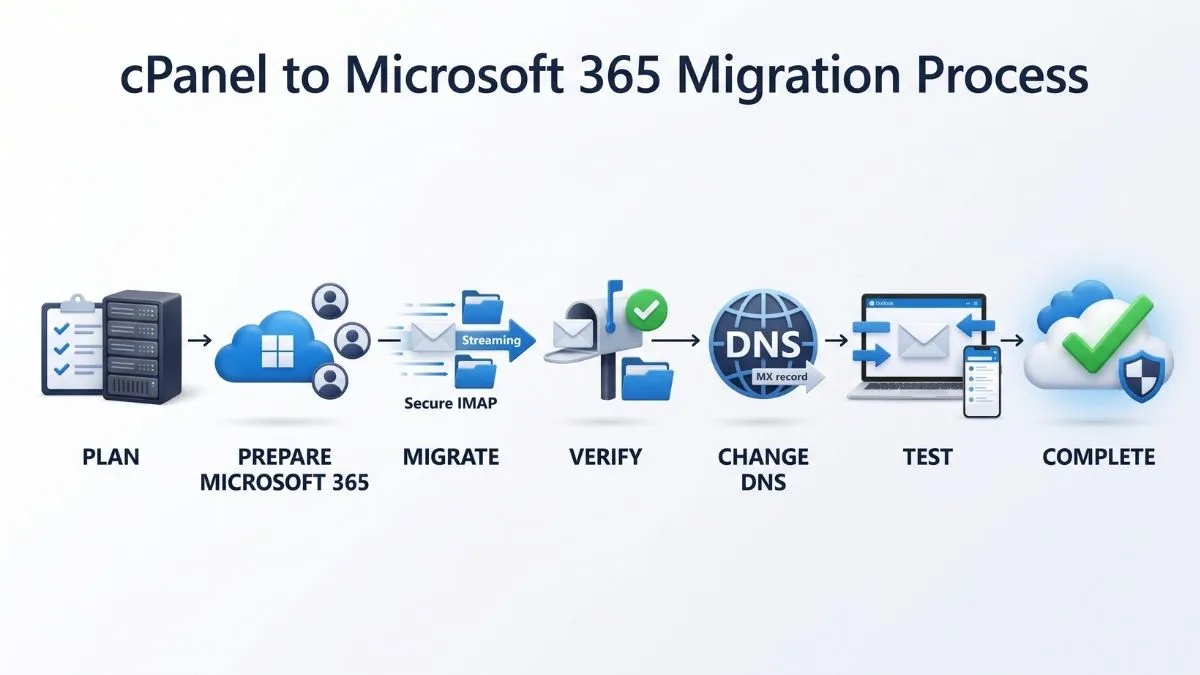
Plan → Prepare Microsoft 365 → Migrate → Verify → Change DNS → Test → Complete
Before changing DNS, make sure all Microsoft 365 users are created, licenses are assigned, mailboxes are ready, the migration batch has been tested, and important folders have been checked.
After cutover, test incoming mail, outgoing mail, Outlook web, Outlook desktop, mobile access, shared mailboxes, SPF, DKIM, DMARC, and Autodiscover.
For business owners and IT administrators, the real goal is not only moving historical emails. The real goal is reliable mail flow, reduced disruption, proper email authentication, and a smooth user experience after migration.
If your business depends heavily on email, avoid rushing the process. A controlled migration plan can help prevent data loss, downtime, and post-migration confusion.